Do vibration plates work in Australia — the short answer
Narrowly. Whole-body vibration lifts bone density at a few hip sites and helps leg strength in older adults, on low-certainty evidence. The plates selling for $99 at Kmart publish 7–15 Hz against the 20–40 Hz the trials used, so the research effect is not the one you are buying.
That is the whole finding on whether vibration plates work: Australia’s price ladder for them runs from $99 to $18,495, and no published evidence says the top of it buys a bigger bone effect. The rest of this piece works through the buyer’s questions in order. What the trials measured site by site, how trustworthy that evidence is, which settings produced it, whether the Kmart machine matches them, whether the “lymphatic drainage” line in the listing titles holds up, what happens to weight and muscle, what $4,895 actually buys, how long these things last, and which one to buy.
We have not lab-tested a vibration plate. This is an editorial audit of published spec sheets, peer-reviewed meta-analyses and the Australian owner record, with every price checked on 11 September 2026.
Do vibration plates actually build bone density?
Only narrowly, and by site. A 2026 BMC Musculoskeletal Disorders meta-analysis of 14 trials (1,447 older adults) found gains at Ward’s triangle and the greater trochanter but nothing measurable at the total hip or L1–L4 spine. A 2025 PeerJ meta-analysis of 7 trials found a small total-femur effect only, graded low certainty.
The numbers behind that, from Chen, Li and Chen (BMC Musculoskeletal Disorders, January 2026): Ward’s triangle came in at WMD 0.04 (p<0.00001) and the greater trochanter at WMD 0.03 (p=0.0002). The femoral neck moved 0.01 (p=0.01), the L2–L4 spine 0.04 (p=0.003). Total hip: WMD 0.01, p=0.56. At L1–L4 the weighted mean difference was 0.00 against a p-value of 0.79, which is about as close to nothing as a pooled estimate gets.
Massini and colleagues (PeerJ, May 2025) pooled 7 randomised trials and 202 adults aged 55 and over. Total femur areal BMD improved by Hedges’ g=0.28 (p=0.04). The femoral neck came in at g=0.15 (p=0.19) and the lumbar spine at g=0.13 (p=0.31), neither of them significant.
Site-specific is the word that matters if you have just been handed an osteopenia result. Ward’s triangle and the greater trochanter are small regions inside the hip. The scores a GP or endocrinologist usually acts on are the total hip and the L1–L4 lumbar spine, and those are precisely the two sites where the 2026 pooling found nothing: p=0.56 and p=0.79.
Older work keeps the field contested rather than settling it. A quality-assessed review indexed in the DARE database (year not stated in the record we hold) found five trials reporting BMD increases of 0.4% to 10.2% over six to 12 months, and three trials reporting no statistically significant difference at all.
How trustworthy is that bone evidence?
The certainty grading tells you more than the p-values do. Massini and colleagues rated the certainty of their own 2025 evidence as low. That is the authors of the most favourable recent pooling putting a warning label on it themselves.
The 2026 BMC Musculoskeletal Disorders review scored its included trials at TESTEX 9.5, which is good methodological quality, then reported that only 21% were low risk of bias. The other 79% carried “some concerns”.
Then there is the double-counting problem. A 2024 overview in BMC Women’s Health examined eight systematic reviews of whole-body vibration and bone density in post-menopausal women and measured their overlap at a corrected covered area of 16.13%. Eight reviews that read like eight confirmations are largely the same small pool of trials counted again. Only one of the eight found a whole-body BMD advantage over conventional exercise, at SMD 0.09.
What frequency and amplitude did the research actually use?
Massini and colleagues state the protocol range plainly: frequencies of 20 to 40 Hz, amplitudes of 2.0 to 5.0 mm, sessions of up to 30 minutes, three times a week (PeerJ, 2025).
Both halves of that specification do work. Frequency is how many times per second the platform reverses direction; amplitude is how far it travels each time. A machine can hit a stated Hz band at a fraction of a millimetre of travel and transmit almost nothing into the femur. Which is why a maker that publishes frequency but no amplitude cannot be checked against the trial protocol at all, and a maker that publishes neither cannot be checked against anything.
Hold 20–40 Hz and 2–5 mm against every Australian listing below.
Does the $99 Kmart plate match those settings?
No. Everfit’s own spec sheet for the machine Kmart sells at $99 publishes 7–15 Hz, below the 20–40 Hz used in the bone trials, and no amplitude figure. Big W’s Advwin listings at $112.90 and $119.90 publish no amplitude either. Checked 11 September 2026.
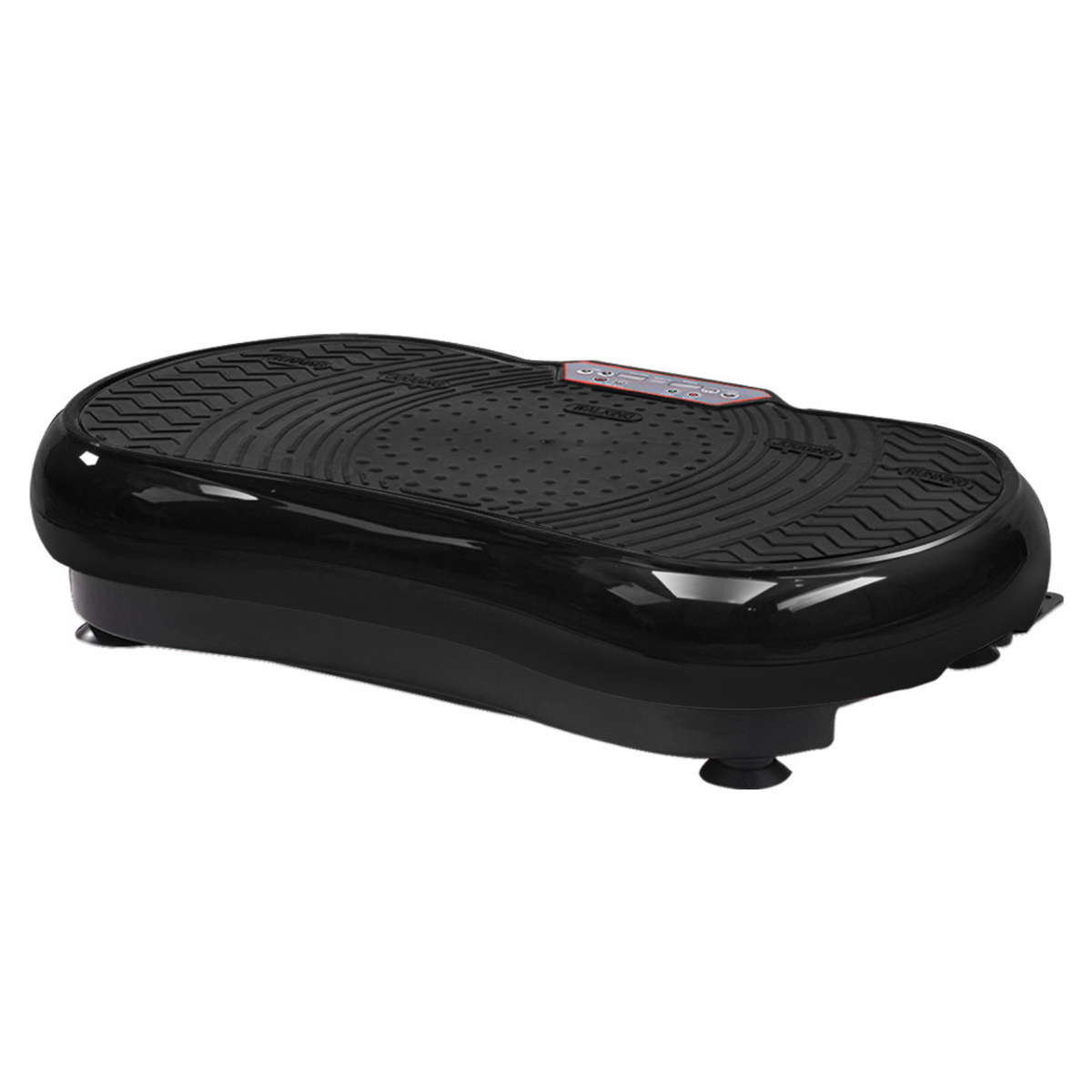
Everfit’s product page for the Everfit Vibration Machine Platform gives 7–15 Hz, 99 speed levels, 180 kg weight capacity, 14 kg net weight, dimensions of 70 x 39 x 13 cm, an inbuilt motor fuse and an SAA-approved plug. Kmart’s own listing adds a dual-belt motor and 10 auto programmes. It is a fully specified machine. The specification just sits under the band that produced the published bone results.
Note what “99 speed levels” and Big W’s “200 speeds” are not. They are controller increments, not frequency figures, and neither maker publishes a mapping from speed 1 or speed 99 to a number in hertz. You cannot convert them, so you cannot verify them.
The honest reading at $99: this is a gentle-movement habit machine. Something that moves under your feet for ten minutes a day at a price most people will not resent. If rebuilding bone is the actual goal, buy a plate whose maker publishes both frequency and amplitude inside the trial band, or put the $99 and the next few hundred dollars toward loaded resistance training, which is the comparator these same reviews use.
See the Everfit listing at Kmart for what a plate in this tier is going for now.
Do vibration plates help lymphatic drainage or detox?
There is currently no concrete evidence that vibration plates support lymphatic drainage, and claims of cellulite reduction are mostly unsupported (OhioHealth claim review). That is the answer, and it applies to a claim that is printed in the product titles themselves.
The MERACH CV30Pro listing on Amazon Australia carries “Lymphatic” inside its own product slug. Power Plate Australia’s marketing says the reflex response “helps boost circulation and lymphatic flush” across sessions of 15 to 30 minutes. Both are marketing copy. Neither is trial data, and neither appears in the meta-analyses above.
Check the current price on Amazon if you want that listing, but buy it for the warranty terms rather than the title.
Who should not use a vibration plate?
Two groups, on what this evidence set records. Anyone buying a $99 to $120 supermarket-tier plate to rebuild bone after an osteopenia or osteoporosis diagnosis is buying published 7–15 Hz against a 20–40 Hz, 2–5 mm protocol, and the money does more in loaded resistance training. Anyone managing lymphoedema or post-surgical swelling should not buy a plate on the strength of the listing title either: vibration does not restore damaged lymph nodes or reverse established fibrosis, and clinician-guided decongestive therapy and manual drainage remain the treatment, with vibration at best an addition your treating clinician agrees to. Beyond those two groups our evidence set holds no medical contraindication list, so put the question to your GP rather than the product page.
Do vibration plates help you lose weight or build muscle?
Nothing in the evidence set supports a weight-loss claim, so we will not imply one. What has been measured is strength and function in older adults.
A 2020 meta-analysis in European Review of Aging and Physical Activity pooled seven publications from six studies, 223 participants with sarcopenia, and found a significant improvement in muscle strength after whole-body vibration therapy: SMD 0.69, 95% CI 0.28 to 1.11, I²=0%, p=0.001. Sit-to-stand and timed-up-and-go both improved too. Those are the outcomes that decide whether a 70-year-old gets off a low chair unaided.
Temper it with the newer work. Beom, Lim and Lee (Scientific Reports, 2026) searched PubMed-MEDLINE, Embase and the Cochrane Library through March 2025 and still describe the sarcopenia evidence as inconsistent.
So there is a defensible reason for someone in their sixties to stand on one of these: leg strength and standing balance. Rebuilding a skeleton is not on that list.
Is a $4,895 Power Plate MOVE different from a $99 plate?
Different build, different service path, and no published bone advantage in this evidence set. The trials pooled by BMC Musculoskeletal Disorders and PeerJ do not test brands. They test frequency, amplitude and dose.
On that measure the MOVE does beat the Kmart machine on paper. Power Plate Australia publishes 30–40 Hz across six levels for the MOVE — 30, 35 and 40 Hz, each at Low or High — plus a 136 kg load capacity, checked 11 September 2026. That band sits inside the 20–40 Hz the trials used and Everfit’s 7–15 Hz does not. But Power Plate publishes amplitude only as Low or High, with no millimetre figure anywhere, so the dose used in the trials cannot be reproduced from the spec sheet at either end of the ladder.
Here is the full Australian ladder on one page, all checked 11 September 2026. Everfit at Kmart, $99. Advwin at Big W, $112.90 and $119.90. MERACH CV30Pro on Amazon Australia, from $199.99 on the day we looked. Hypervibe G10 Mini, RRP $1,649, and G14 Home, RRP $3,849 (ProductReview listings, 2026). CardioTech VT-20, RRP $1,970. Then Power Plate Australia’s own store: Personal Power Plate RRP $3,799, Power Plate MOVE RRP $4,895, my7 RRP $11,995, pro5 RRP $18,495, all distributed here by NovoFit Pty Ltd.
Kmart to the MOVE is a 49x spread. What the extra $4,796 buys is commercial-grade hardware inside the trial frequency band, an identified Australian distributor and someone to call. What it does not buy, on anything published, is a larger number on your next DEXA scan.
See the MOVE at Power Plate Australia for what the platform tier costs today.
How long will one of these last, and what happens if it dies?
Nobody can quote an Australian fault rate for vibration plates. ProductReview’s entire vibration machines category rests on 57 reviews across every brand listed as at 2026, which is far too thin to calculate reliability by brand.
So treat the failures on record as anecdotes, because that is what they are. An ALDI Vibration Plate that developed a grinding noise and stopped working at about five months, refunded through the supplier because no replacement existed. An ALDI Genki Ultra Slim that runs roughly two minutes then stops until the reset button is pressed, with the owner unable to get it repaired. A CardioTech LifeBack delivered with the power cord missing and footprints on it. A Power Plate my7 paid for in full, with delivery slipping by months and calls and emails unanswered.
The positive outlier is an anecdote too, and a big one: a Hypervibe G14 Home owner with osteoporosis reported a 7.5% DEXA gain after eight months of daily 10-minute sessions. One self-reported result on one machine. Not a trial, and not a reason to spend $3,849.
With no fault rate available, the published warranty and returns terms are the only decision-grade data in this category. Amazon Australia’s MERACH CV30Pro listing publishes a 1-year manufacturer warranty, sold by Merach Fitness, shipped by Amazon, with 30-day change-of-mind returns. Vibration Therapeutic publishes a 10-year warranty and a 90-day return window on its VT007 direct, the longest term in this evidence set, though it is not an Australian retail listing. Keep your receipt either way: Australian Consumer Law rights sit on top of any manufacturer warranty, and at $99 to $119.90 the cost of a failed unit is the whole purchase price.
Where each machine actually lands
Filed by the question each one answers, not ranked.
| Product | Retailer | Price checked 11 Sep 2026 | Published frequency | Published amplitude | Warranty / returns | Where to buy |
|---|---|---|---|---|---|---|
| Everfit Vibration Machine Platform | Kmart Australia | $99 | 7–15 Hz (Everfit) | Not published | Not published on listing | Check the Everfit at Kmart |
| Advwin Vibration Plate with Light | BIG W | $119.90 | Not published | Not published | Not published on listing | See the Advwin listing at BIG W |
| MERACH CV30Pro | Amazon Australia | From $199.99 (Amazon AU, checked 11 September 2026) | Not published | Not published | 1-year manufacturer, 30-day change of mind | View at Amazon AU |
| Power Plate MOVE | Power Plate Australia (NovoFit) | RRP $4,895 | 30–40 Hz, 6 levels (Power Plate Australia, 2026) | Low/High only, no mm published | Via NovoFit | See the MOVE at Power Plate Australia |
The cheapest way to stand on something that moves
The Everfit Vibration Machine Platform at $99, with 7–15 Hz published and 180 kg capacity. Buy it for a daily ten-minute habit, not for your femoral neck.
Check the Everfit price at Kmart.
The same tier, with handles
Big W’s Advwin Vibration Plate Exercise Machine with Light at $119.90, and the push-up-handle sibling at $112.90 with 150 kg capacity, 200 speeds and 6 preset workouts. Neither listing publishes frequency or amplitude, so neither can be checked against the 20–40 Hz protocol. The $20.90 premium over Kmart buys handles and a light.
The best published returns and warranty terms
The MERACH CV30Pro holds 4.4 out of 5 from 763 Amazon Australia ratings and ranks #5 in Vibration Platform Machines, with a 1-year manufacturer warranty and 30-day change-of-mind returns. Its lowest listed offer on Amazon AU was $199.99 on 11 September 2026, one of two offers showing alongside a newer version of the model, so both the offer count and the entry price move. In a category with no measurable fault rate, that warranty paperwork is the reason to pick it. The “Lymphatic” in the listing title is not.
The lineage the marketing borrows from
The Power Plate MOVE, RRP $4,895 (Power Plate Australia, 2026), distributed here by NovoFit Pty Ltd. Commercial hardware with a named distributor and a published 30–40 Hz range, and the my7 delivery anecdote above as a caution about how the service side has gone for at least one Australian buyer.
View the MOVE at Power Plate Australia.
So which one should you buy?
For most Australians asking whether vibration plates work, the call is that the $99 Everfit is worth $99 as a gentle-movement habit and nothing more, and the $4,895 Power Plate MOVE carries no published bone evidence the $99 machine lacks, even with its frequency inside the trial band. The Advwin pair at Big W sit in the same tier as the Everfit, with handles and no amplitude figure.
If you have just been told you have osteopenia, spend the money on loaded resistance training first and raise vibration with your GP rather than instead of one. The measured bone effect is site-specific, small, and graded low certainty by the people who measured it.
If you want a plate anyway, buy where the terms are published. That points to the MERACH CV30Pro and its 1-year warranty and 30-day change-of-mind window, because reliability data for this category does not exist in Australia.
Do not buy one to treat lymphoedema, and do not buy one to lose weight.
The question was never which plate. It was whether an effect this small, at these two hip sites, is worth any price at all, and for most buyers the answer is that $99 is the most it is worth. All specs and prices here were checked on 11 September 2026.


